
VIP member
Product details
1、 Product Introduction:
One river, one strategy, long-term maintenance, fundamentally solve the problem of black and odorous rivers. Magnetic coagulation sedimentation integrated equipment has high integration and maneuverability, making it very suitable for emergency river treatment and long-term water maintenance. It can greatly reduce indicators such as TP, SS, COD, turbidity, etc. in water bodies. Magnetic coagulation sedimentation technology is the process of synchronously adding magnetic powder to the traditional coagulation sedimentation process, integrating it with pollutant flocs to enhance the coagulation and flocculation effect, resulting in a denser and more solid floc, thus achieving high-speed sedimentation. The settling speed of magnetic flocs can reach over 40 m/h. Magnetic powder is recycled and reused through a high shear machine and a magnetic seed catcher (magnetic separator).
This technology has the characteristics of high settlement, small footprint, and excellent treatment effect. Magnetic flocculation technology has been applied to the treatment of ferromagnetic wastewater from steel mills in China. In recent years, research on the treatment of non ferromagnetic wastewater such as municipal wastewater, oily wastewater, and other industrial wastewater has received attention. Our company has installed and debugged multiple magnetic flocculation sedimentation systems, covering various fields such as industrial wastewater and black and odorous water treatment.
2、 Product Display:

3、 Product features:
The magnetic flocculation precipitation process includes:
Phase 1- Magnetic flocculation reaction: The pollutants are formed into flocs and combined with magnetic powder to ultimately form large and dense magnetic flocs.
The second stage - solid-liquid separation: The high-speed solid-liquid separation process relies on the specific gravity of the magnetic flocs themselves to form a static settling velocity of up to 40m/h or more, thereby quickly separating pollutants from the water.
The third stage - magnetic powder recovery: The magnetic flocs are crushed by a high-speed shearing machine and enter the magnetic separator. On the one hand, the magnetic powder is recovered to the reaction tank for recycling. On the other hand, the separated sludge is discharged into a sludge storage tank for subsequent sludge dewatering treatment.
4、 Product process:
1) Mixing pool
- The mixing pool is generally divided into three pools, which we call T1, T2, and T3 mixing pools.
- The T1 mixing tank is used to add coagulants such as PAC and mix them quickly with the incoming water using rapid stirring. The stirring speed is generally 250r/min.
- T2 mixing tank is used for magnetic powder recovery, magnetic powder feeding tank, and magnetic powder mixing tank in magnetic separators. And use rapid stirring to quickly mix the magnetic powder with the inlet water of the front-end coagulation, with a stirring speed of generally 250r/min.
- The T3 mixing tank is used for the addition and mixing of coagulants, which better drives the settling of magnetic particles and insoluble substances in water. The pool should be stirred at a slow speed, usually set at 70-80r/min. Rapid stirring can break the flocs and cause flocculation failure.
2) Sedimentation tank
The selection of sedimentation tanks is not much different from that of general secondary and primary sedimentation tanks. Considering factors such as land occupation, inclined tube sedimentation tanks are often used. The stable sedimentation of the mixed water body leads to the outflow of the water tank, and the magnetic mixed sedimentation refluxes. The supernatant flows smoothly out of the outflow tank. Simultaneously equipped with a scraper to prevent the deposition of magnetic powder and mud at the bottom, facilitating better reflux.
3) Backflow sludge discharge system
Reflux and sludge discharge are very important in magnetic coagulation technology. Reflux is mainly used for the reflux of magnetic powder, while maintaining the balance of sludge volume inside the tank. The reflux ratio is generally 8% to 12% of the inlet water volume, and can be appropriately increased with the increase of inlet water volume. The sludge pump corresponds to the residual sludge pump on the self-control diagram, and its function is to remove excess sludge at a specific time to maintain normal solid load in the tank.
Usually, two sets are arranged for reflux and sludge discharge, with one set for backup.
4) Dosing system
coagulantGenerally, PAC, PAFC and other agents are used. Studies have shown that with PAC dosage of 25-30mg/L, the removal rate of turbidity and total phosphorus can reach 90%. However, in actual operation, the PAC dosage needs to be adjusted to 50-80mg/L according to the removal of total phosphorus in the front-end, which can be adjusted according to the actual situation.
magnetic powderThe particle size of magnetic powder increases, the specific surface area rapidly decreases, and the contact area between magnetic powder and pollutants is greatly reduced. The specific gravity of magnetic powder is much greater than that of water, and large particles of magnetic powder are prone to quickly sink. To achieve high magnetic particle flocculation rate, the magnetic particle size should not exceed 10 μ m. In addition, the added magnetic powder partially precipitates on its own, and most of it is flocculated into large flocs by the flocculant and precipitates. The appropriate amount of addition depends on the concentration of pollutants (the formed flocs can be observed as a reference for the amount added), otherwise either too little will result in the magnetic properties of the flocs not meeting the requirements, or too much will waste magnetic seeds. At the start of the trial run, a dosage of 100mg/L can be added for testing, and during subsequent continuous operation, the dosage can be adjusted based on the daily water volume and operating conditions.
flocculantThe dosage of flocculant is also determined by observing the flocs. Increasing the dosage of flocculant does not improve the magnetic particle flocculation rate, and excessive dosage can lead to flocculation failure. At present, the dosage of PAM in urban sewage treatment plants is generally 0.5-1mg/L. During the commissioning period, the most suitable ratio can be tested according to this dosage.
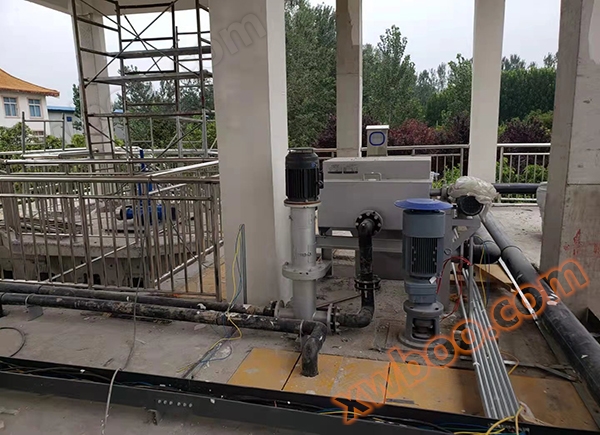
5) Magnetic powder recycling equipment: magnetic separator and high shear machine
The magnetic powder separator utilizes the magnetic force generated by the permanent magnet system to adsorb the magnetic seed particles in the feed onto the surface of the cylinder and rotate with the cylinder. After the magnetic field is removed, the magnetic seeds are recovered under the action of a scraper or flushing water, instead of non-magnetic materials being discharged from the sludge discharge outlet, thus completing the recovery of magnetic seeds (magnetic powder, magnetic medium).
For more product information, please click
Online inquiry
-
Contacts
-
Company
-
Telephone
-
Email
-
WeChat
-
Verification Code
-
Message Content
-